
Surge protectors: How to shield your devices from power spikes

We plug in laptops, phones, and tablets every day without even thinking about it. However, if a sudden power surge hits your electricity network, your devices may be at risk. If this happens, a surge protector may save your devices from damage, so you can keep using them safely.
Having too much power
So, what causes a power surge and why can it be it so damaging?
Electricity usually flows to your home in a safe way to power your devices without problems. Sometimes, sudden energy spikes can overload the system, causing too much power to reach plugged-in devices. This can damage their parts, even if they're switched off.
Energy networks may have minor voltage changes that won’t instantly harm your devices but may wear them out over time. Larger spikes that cause major damage are rare but can happen in some situations.

When lightning strikes
Lightning strikes are a well-known cause of power surges. If your home gets a direct hit, it’s unlikely that surge protectors will be able to withstand it. That’s why it’s always safer to unplug devices during a storm.
When a lightning strike is further away and brings down a power line, for example, you may get a sudden spike. In this case, having a surge protector may help prevent damage to your devices.

During blackouts
If the grid goes down and there’s blackout, there may be a voltage spike when the power comes back on. Again, it’s a good idea to unplug devices during a blackout. However, if you’re not at home at the time, a surge protector is your first line of defence.

Wiring and socket spikes
Voltage spikes can also happen due to faulty wiring or plugging too many devices into one socket. If you notice flickering lights or a burning smell from sockets, call a licensed electrician to check your wiring.

Choose your protector
Surge protectors work by detecting any sudden increase in voltage and then diverting the extra power away from your device – all in a fraction of a second. There are two main types of surge protectors.

1. A whole-of-house protector
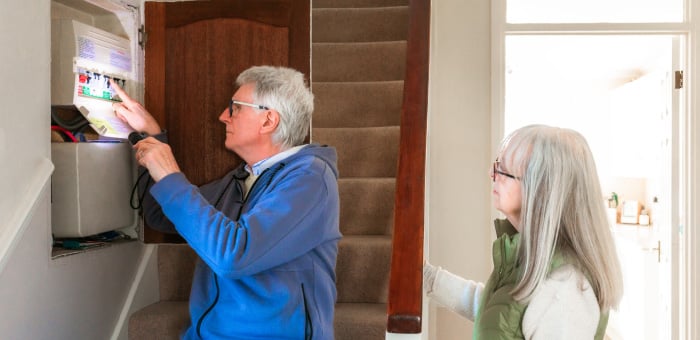
A whole-of-house protector isn’t mandatory in Australia, but you can ask your electrician to install one on your switchboard. Remember, surge protectors are designed to protect your equipment, not you. It’s the circuit breakers on your switchboard that ‘trip’ the power to save you from electric shocks.

2. Plug-in protectors
You can buy plug-in protectors from DIY stores and electrical shops. These may be power boards that allow you to run several devices off a single socket. Or they may plug directly into the socket to protect a single device.
The advantage of plug-in protectors is that you can move them around depending on where your devices are plugged in. The disadvantage is that they only protect the devices plugged into them. So, if you want to protect the whole house, you might need a lot of them.
Some electronic devices are more at risk from power surges than others. That's why it's smart to use surge protectors for devices like computers, home entertainment systems, and game consoles. These items are more sensitive to power surges, and surge protectors can help keep them safe.
It’s a good idea to check the surge protector regularly to make sure it’s working in case there’s been a power spike. Choose one that has an indicator light. Some protectors can be reset if they’re triggered, but you may need to replace it completely if it’s no longer working.
Power surges are difficult to predict and prevent. By installing surge protection in your home, you can help keep your valuable devices up and running if your power supply spikes.
Does home insurance cover power surges?
This depends on your policy and the cause of the power surge. Allianz Home Insurance has certain exclusions for power surges caused by power providers. If a power outage causes damage, you might not be covered.
A power outage by itself doesn’t usually damage devices; the surge when power is restored can. That’s why using surge protectors to help prevent damage to your devices can be a smart move.
However, if an insured event under your policy causes a power surge, you might be covered. For example, a storm. If lightning from a storm causes a power surge that wrecks your TV, you may be covered.
Since claims can be complex, it’s a good idea to make sure you understand your policy. To check what’s covered and what’s not covered, see your Product Disclosure Statement (PDS).
Want to find out more about Allianz Contents Insurance?

Related articles



Disclaimer
This article has been prepared by Allianz Australia Insurance Limited ABN 15 000 122 850 AFSL234708 ("Allianz"). It is a summary of key concepts and not meant to represent the complete picture on any given matter. It is not meant to be legal advice. The information should be read in conjunction with the relevant legislation and regulations. In some cases, information has been provided to us by third parties and while that information is believed to be accurate and reliable, its accuracy is not guaranteed in any way.
Any opinions expressed constitute our views at the time of issue and are subject to change. Neither Allianz, nor its employees or directors give any warranty of accuracy or accept responsibility for any loss or liability incurred by you in respect of any error, omission or misrepresentation in this article.
Any advice here does not take into account your individual objectives, financial situation or needs. Terms, conditions, limits, and exclusions apply. Before making a decision about this insurance, consider the relevant Product Disclosure Statement (PDS)/Policy Wording and Supplementary PDS (if applicable). Where applicable, the PDS/Policy Wording, Supplementary PDS and Target Market Determination (TMD) for this insurance are available on this website. We do not provide any form of advice if you call us to enquire about or purchase a product.
Allianz Australia Insurance Limited ABN 15 000 122 850 AFS Licence No. 234708 is the insurer of any general insurance products offered, and Allianz Australia Life Insurance Limited ABN 27 076 033 782 AFS Licence No. 296559 is the insurer of any life insurance products offered. Each entity is responsible for any statements and representations made about its products, on this website.